
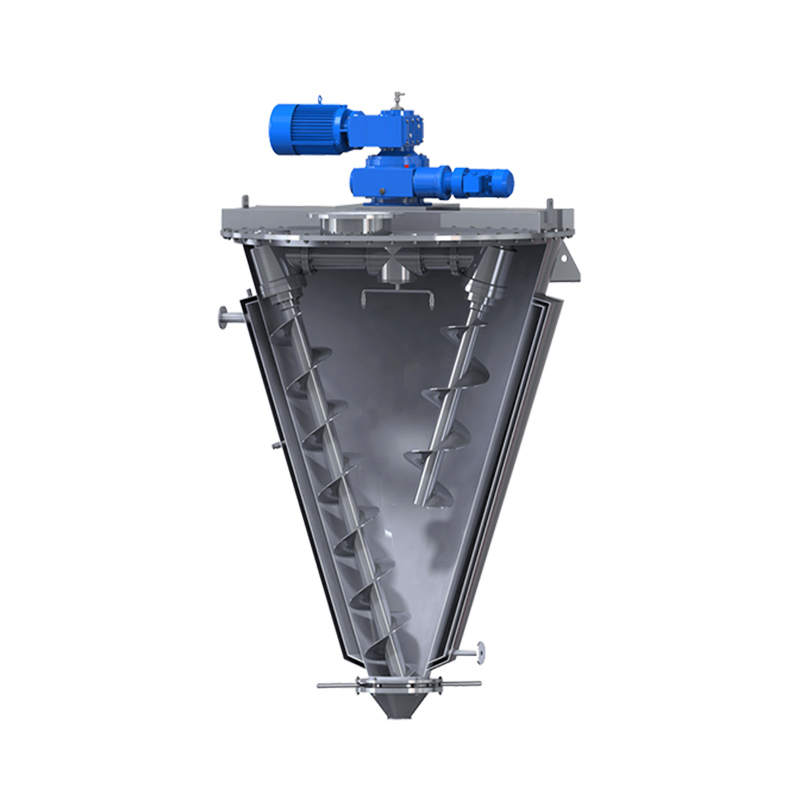
 Conical Screw Mixer
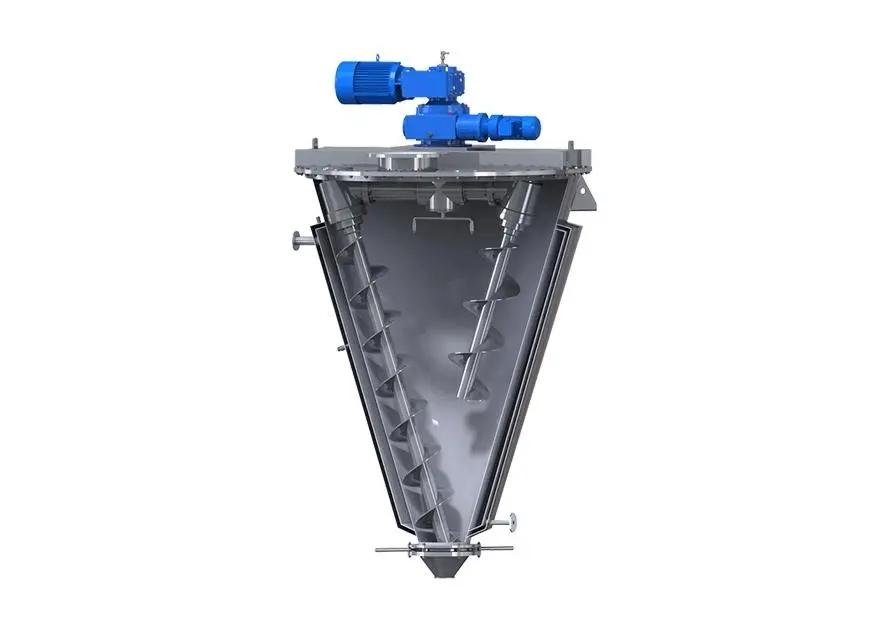
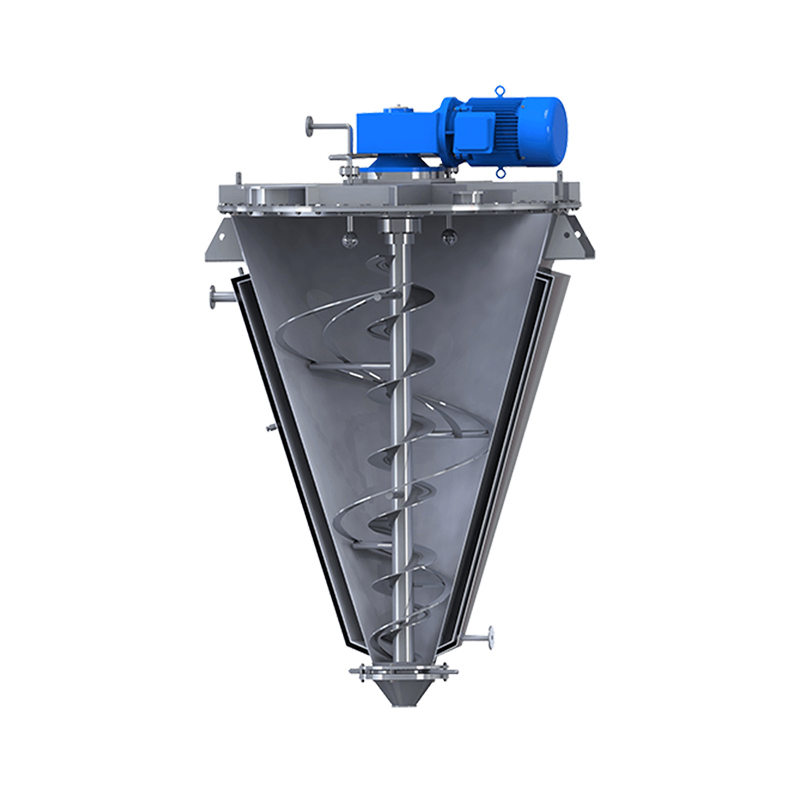 Conical Screw Belt Mixer
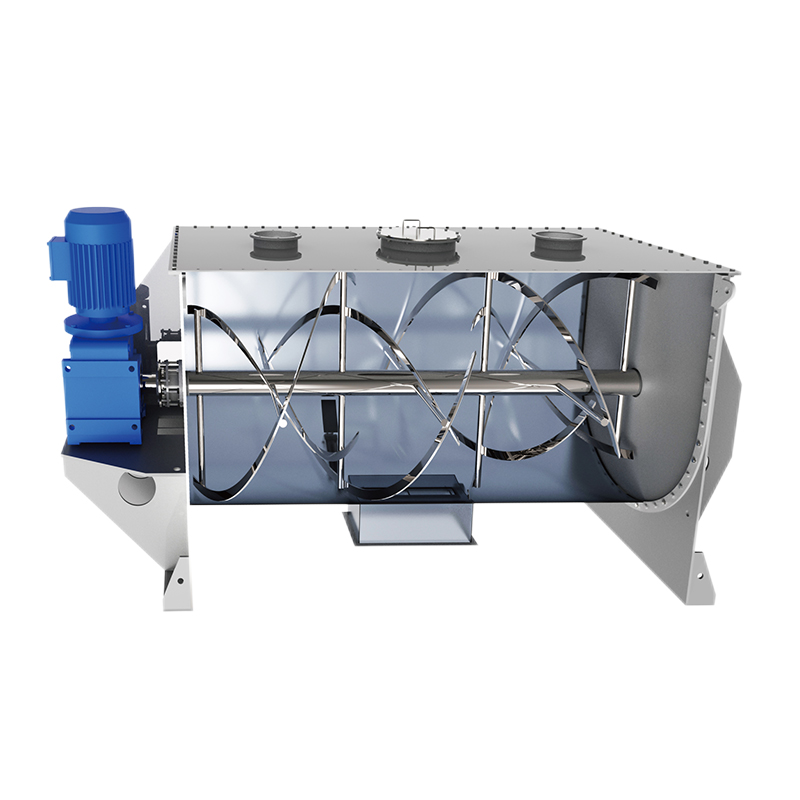 Ribbon Blender
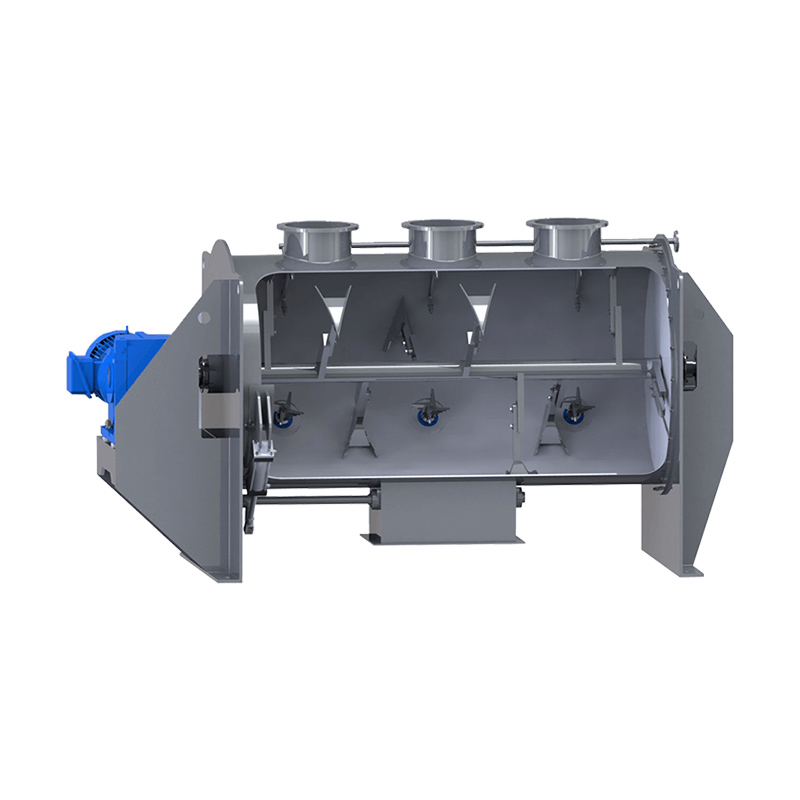 Plough-shear Mixer
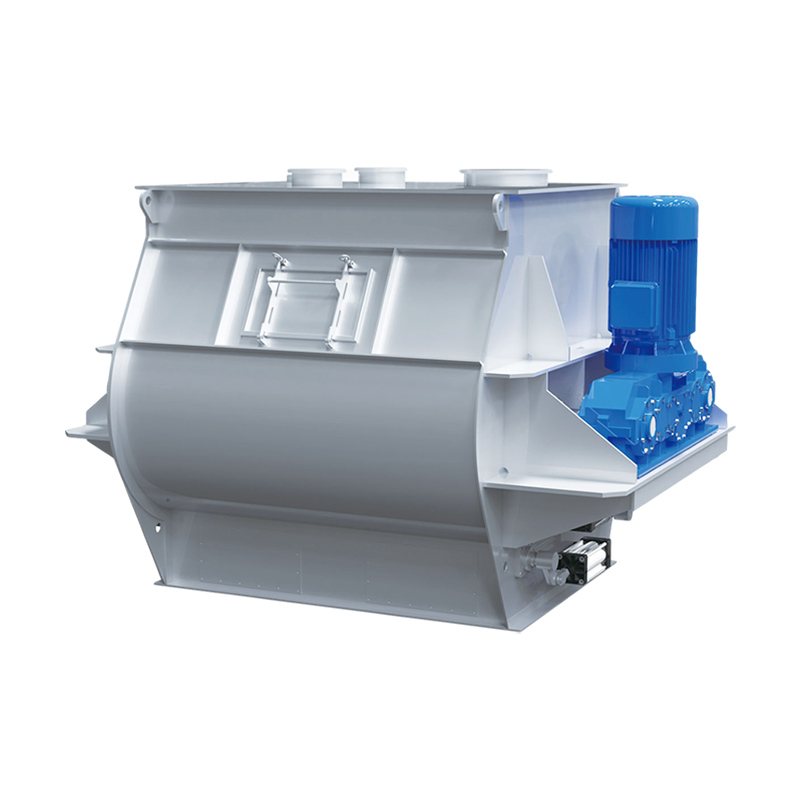 Double Shaft Paddle Mixer
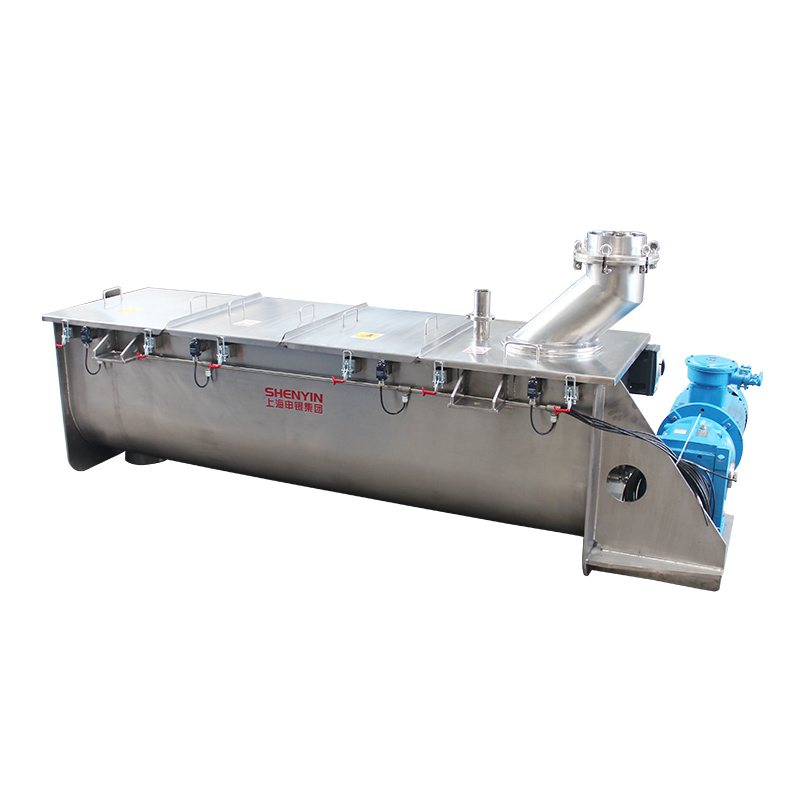 CM Series Mixer


Easy Guide to Choosing Your Conical Screw Belt Mixer Capacity
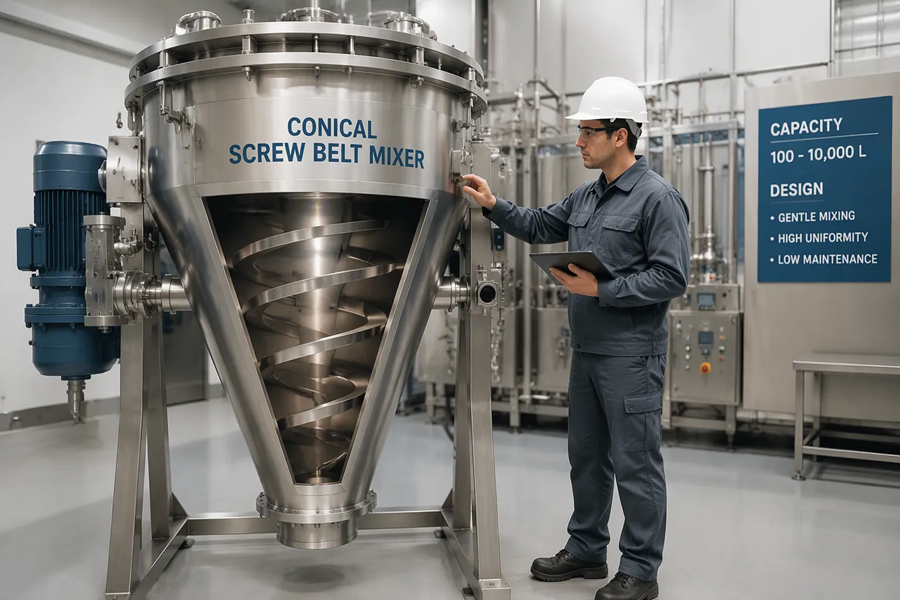
Your batch size should be between 30% and 80% of the mixer's total vessel volume. I treat this rule as the foundation of every capacity decision. Get it wrong, and you pay for a machine that either wastes space or chokes on your powder.
I wrote this guide to help you calculate that batch size and match it to the right machine. Today's Conical Screw Belt Mixer units range from 50 to 5,000 liters. Low-shear mixing runs at screw tip speeds between 0.5 and 2 meters per second, so gentle handling matters too.
I will walk you through a clear, step-by-step process. You will avoid costly over-sizing and under-sizing.
- Keep your batch size between 30% and 80% of the mixer's total volume.
- Calculate your batch volume using your daily production target and powder density.
- Adjust the fill level based on your powder's flowability and density.
- Test your powder with a supplier to confirm the right mixer capacity.
- Plan for future growth by choosing a mixer that can handle increased volume.
Start with Your Batch Size
Define Your Production Goal
I begin every capacity decision with one question: what volume of material do you need to mix per cycle? The answer comes from your daily production target.
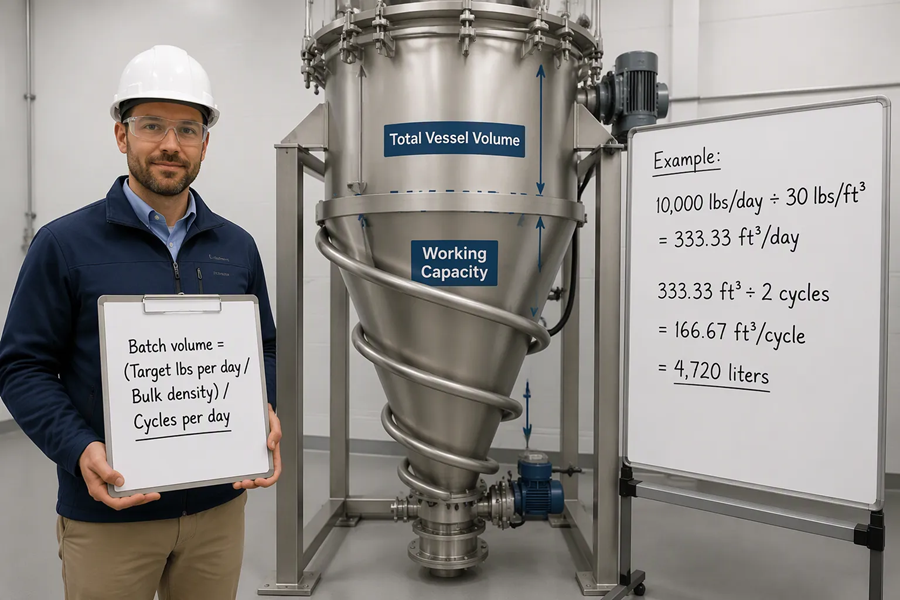
Here is how I calculate it. First, take your target in pounds per day. Divide that number by the bulk density of your powder (in pounds per cubic foot or pounds per liter). This gives you the total volume your process requires per day. Next, divide that daily volume by the number of mixing cycles you can run each day. The result is the batch volume per cycle.
I find this formula works well in practice:
Batch volume = (Target lbs per day / Bulk density) / Cycles per day
Let me walk you through a real example. Suppose you need 10,000 pounds of finished powder every day. Your material has a bulk density of 30 pounds per cubic foot. You plan to run two cycles per day.
Step 1: 10,000 lbs ÷ 30 lbs/ft³ = 333.33 cubic feet per day.
Step 2: 333.33 ft³ ÷ 2 cycles = 166.67 cubic feet per cycle.
That is your batch volume. To convert to liters, multiply cubic feet by 28.317. In this case, 166.67 ft³ × 28.317 = 4,720 liters per cycle.
I always round up slightly to account for small variations in density and downtime. A batch volume of 4,700 to 4,800 liters is a safe starting point here.
Understand Your Conical Screw Belt Mixer Capacity
Once you have your batch volume, you need to match it to the right mixer. The first thing I do is distinguish between two key terms: total vessel volume and working capacity.
Total vessel volume is the full internal space of the mixer when it is empty. Working capacity is the actual volume of powder you can safely load into the mixer during operation.
| Term | Definition | Typical Relationship |
|---|---|---|
| Total vessel volume | The complete internal space of the mixer | 100% of the vessel |
| Working capacity | The usable space for a batch | 30% to 80% of total volume |
The 30-80% rule is the backbone of my advice. You should never fill a Conical Screw Belt Mixer to less than 30% of its total volume. The screw needs enough material to mix efficiently. Fill it above 80%, and you risk overloading the drive.
Adjust for Powder Characteristics
Factor in Bulk Density and Flow
Bulk density tells me how much space a given weight occupies. Flow behavior tells me whether the powder moves freely or sticks together. These two properties decide where I set the fill level inside the 30-80% window.
A dense, free-flowing powder packs tightly. I can safely load this material closer to 80% of the total volume. A light, aerated, or sticky powder behaves differently. I must keep the fill level low, usually between 30% and 40%.
Account for Mixing Time and Shear
Delicate products need a Gentle Mixing action. I use the available data on screw tip speeds for this decision. A low speed of roughly 0.5 meters per second provides that gentle action.
| Scenario | Effect on Daily Throughput | Sizing Response |
|---|---|---|
| Longer mixing cycle | Throughput drops per hour | Select a larger Batch Mixer |
| Standard mixing cycle | Throughput stays stable | Standard sizing works |
Follow a Clear Selection Process
Use the 30-80% Rule as Your Guide
1. Calculate your batch volume per cycle.
2. Divide that batch volume by 0.8.
3. Divide the batch volume by 0.3.
4. Your ideal mixer total volume falls between those two numbers.
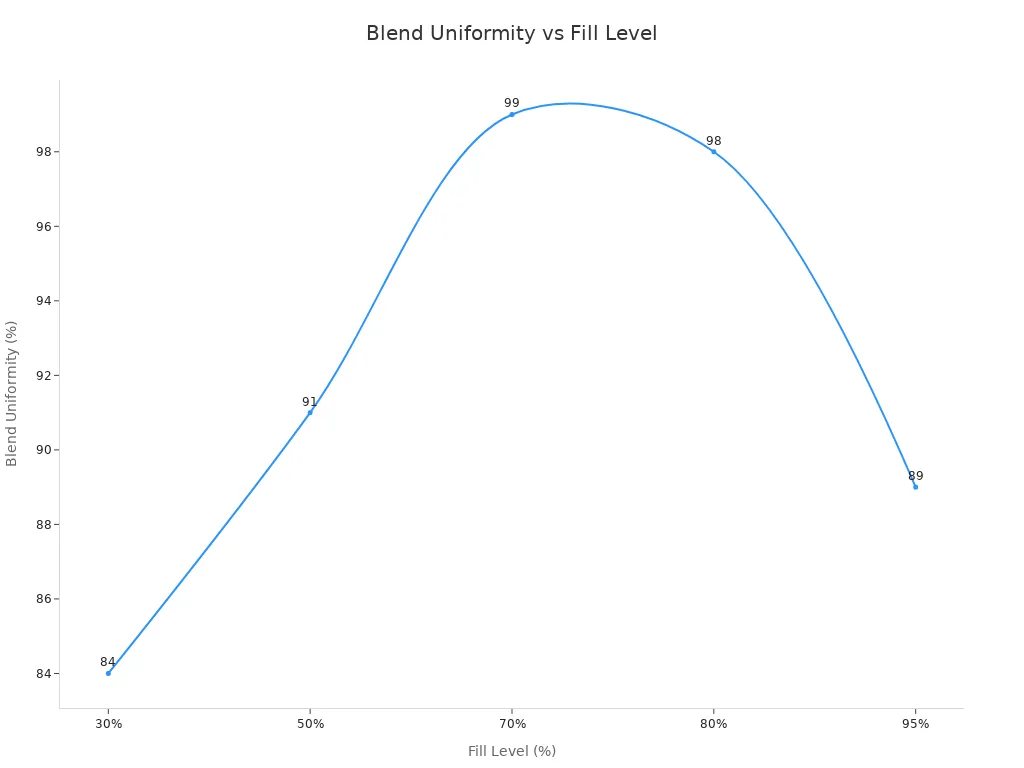
| Fill Level (%) | Blend Uniformity (%) |
|---|---|
| 30 | 84 |
| 50 | 91 |
| 70 | 99 |
| 80 | 98 |
| 95 | 89 |
Pilot Tests and Manufacturer Input
| Material Property Oversight | % of Projects Affected |
|---|---|
| Viscosity mismatch | 95% |
| Particle size ignored | 84% |
| Density underestimated | 75% |
I recommend contacting a supplier like Shenyin Group for a test. Reliable suppliers offer lab-scale trials as part of the sales process.
Choosing the right capacity for your Conical Screw Belt Mixer comes down to three rules. First, keep your batch between 30% and 80% of the total vessel volume. Second, account for your powder's bulk density and flowability. Third, validate your choice with a manufacturer's test.
FAQ
What happens if I fill the mixer above 80%?
I see motor resistance climb quickly. Material packs against the vessel top. I risk drive overload and product overflow.
How do I convert my production target to batch volume?
I use this formula: target pounds per day divided by bulk density gives daily volume. Divide that by the number of cycles per day.