
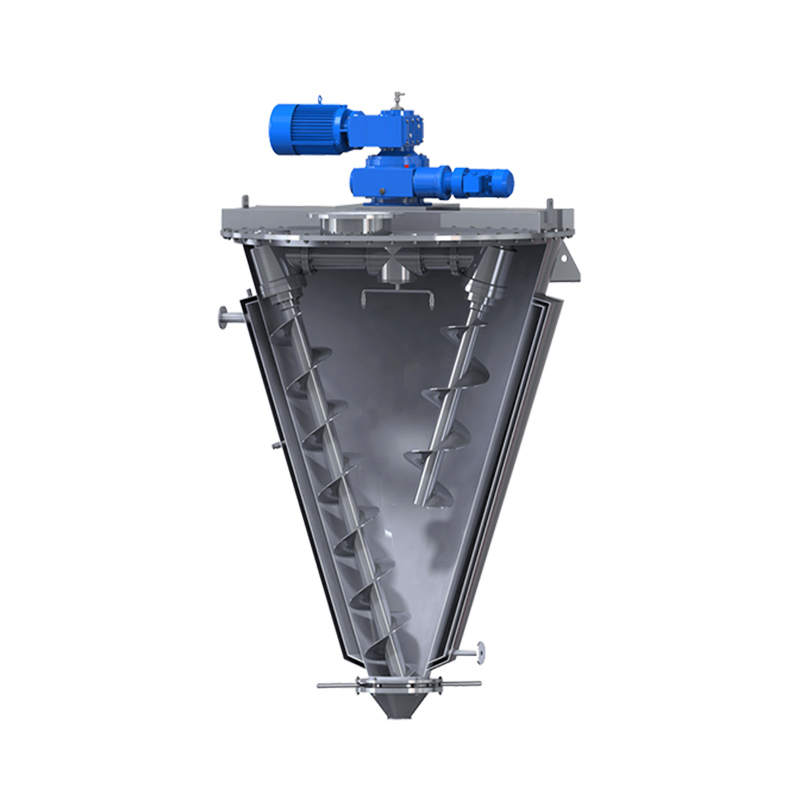
 Conical Screw Mixer
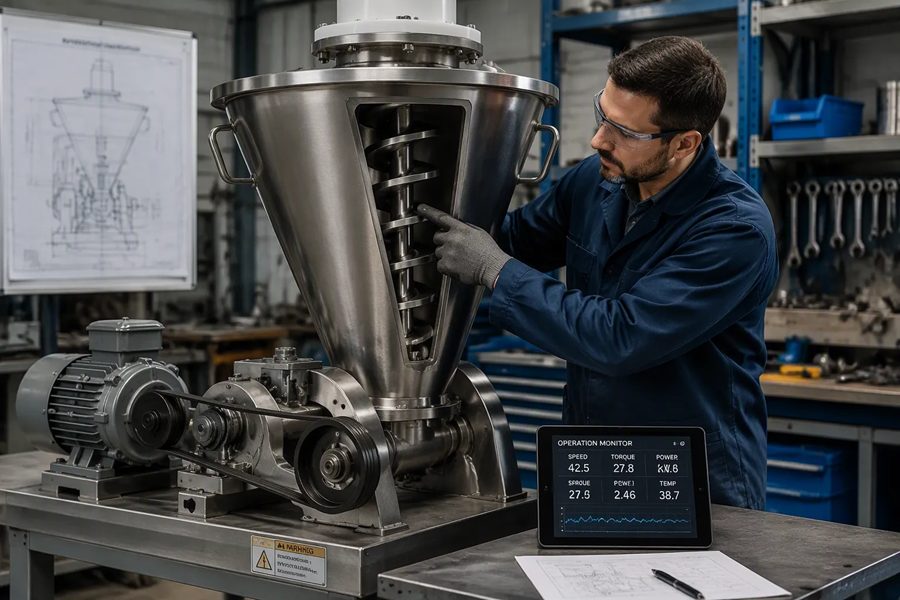
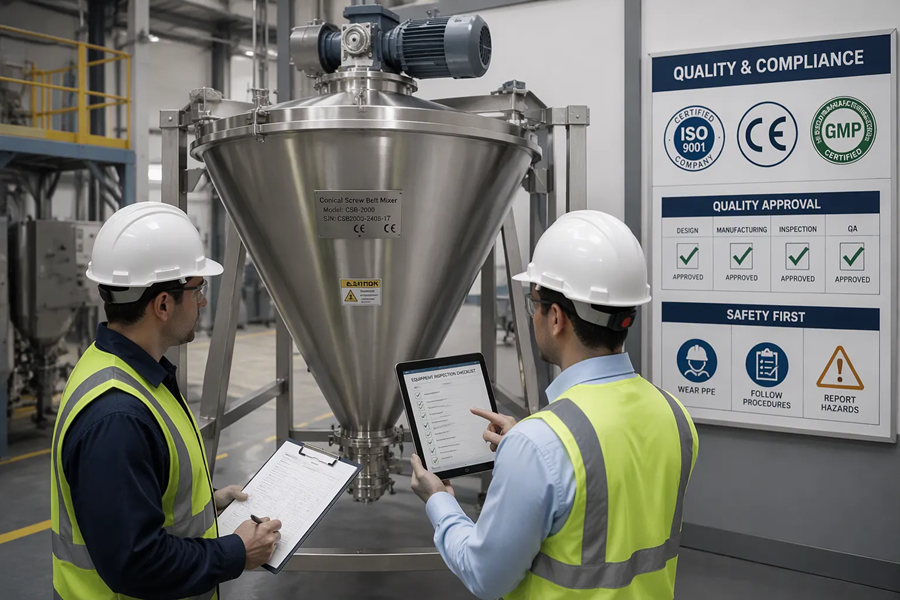
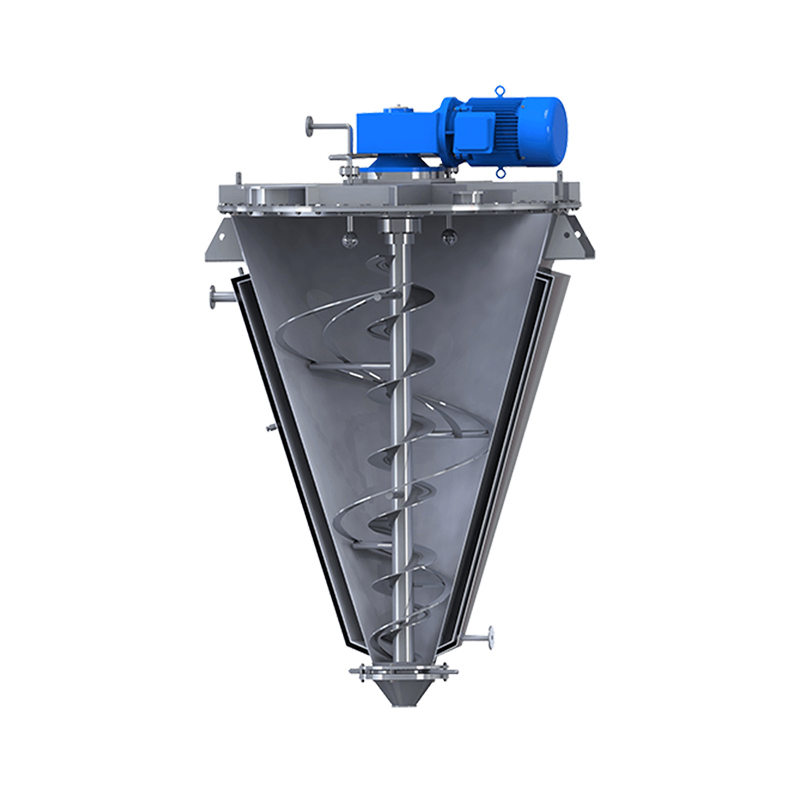 Conical Screw Belt Mixer
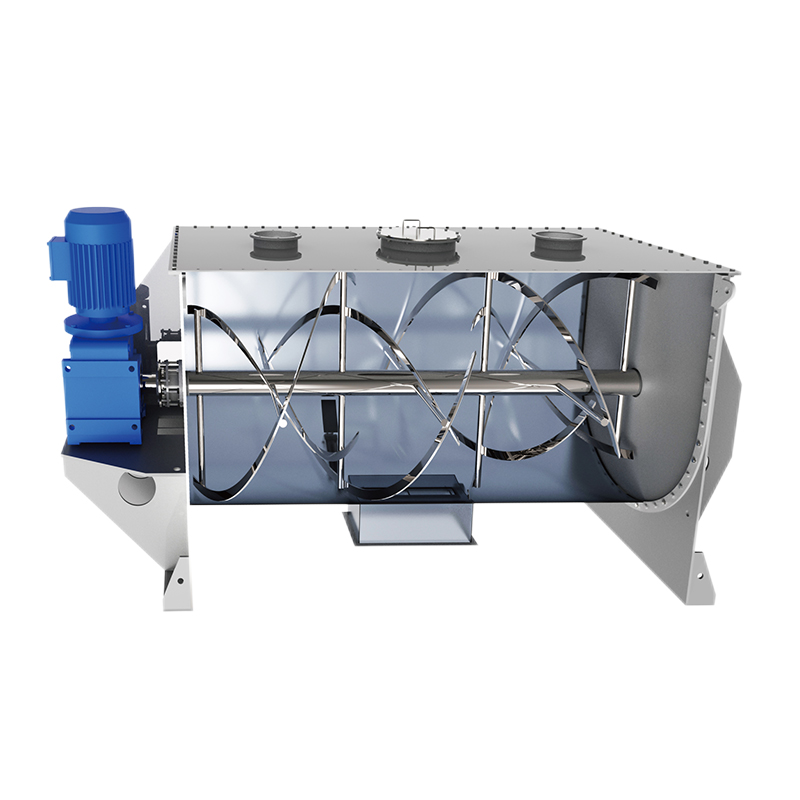 Ribbon Blender
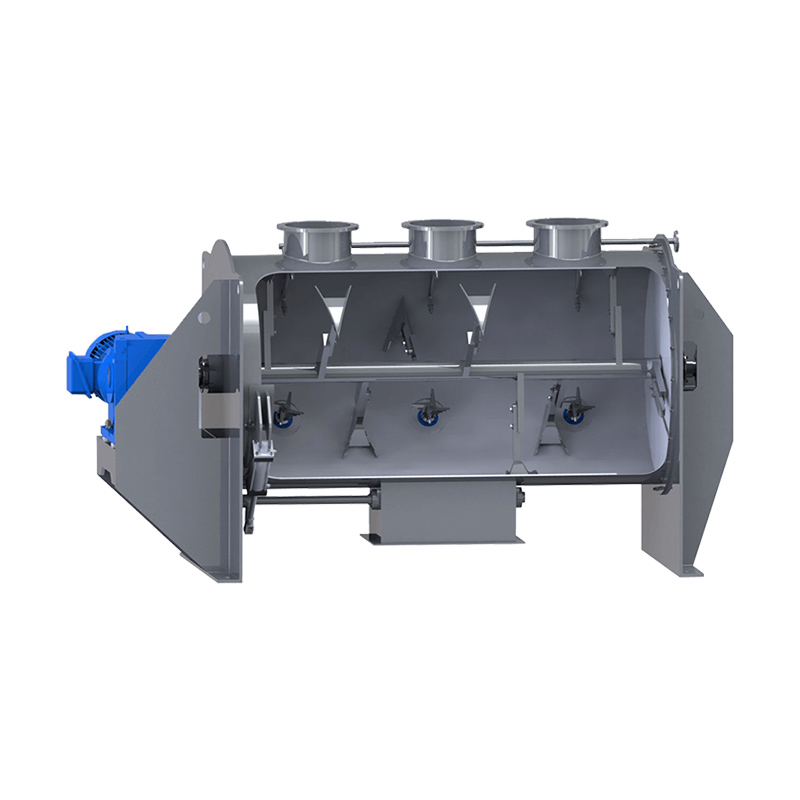 Plough-shear Mixer
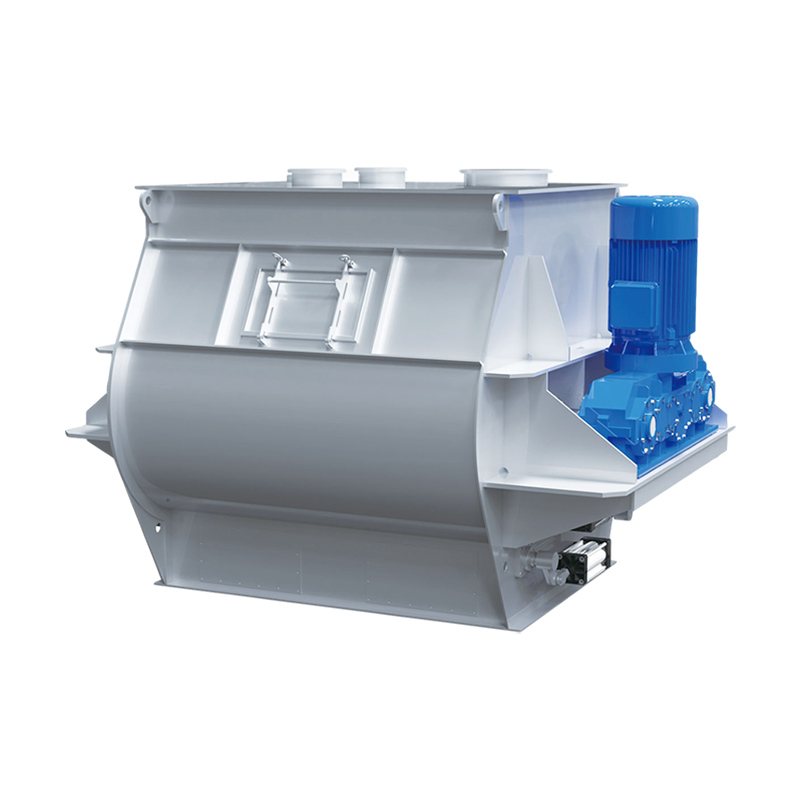 Double Shaft Paddle Mixer
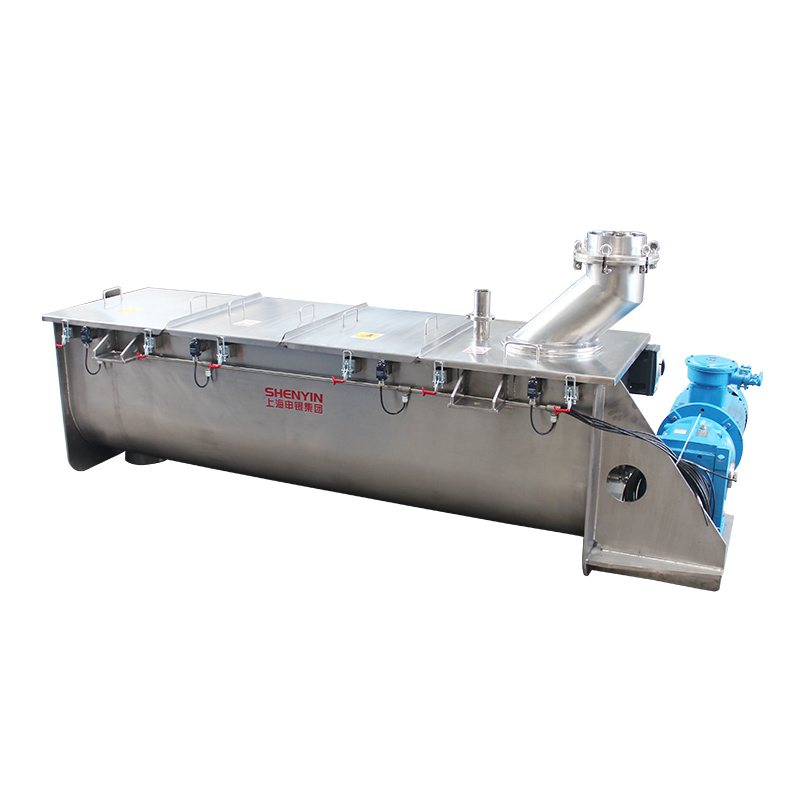 CM Series Mixer




What Core Technical Parameters Should You Review When Purchasing an Industrial Ribbon Blender?
Quick Answer: When purchasing an industrial Ribbon Blender, the core technical parameters to review are effective working volume (not total volume), bulk density compatibility, ribbon-to-trough clearance (typically 3–5 mm or 1/8"–3/16"), motor horsepower relative to product density, discharge valve design, and material of construction. These parameters determine whether the blender will actually achieve uniform mixing at your required batch size without creating dead zones, excessive dust, or cleaning difficulties. A 2026 market analysis shows the global industrial ribbon blender market is projected to reach $191 million by 2032, growing at 5.3% CAGR, with food processing accounting for the largest application share. This article explains each parameter, how they interact, and what numerical values indicate a well-specified blender for your application.
Key Takeaways:
-
Effective working volume is typically 40–80% of total geometric volume—review this figure, not the vessel’s full capacity .
-
Ribbon-to-trough clearance should be tightly controlled at 3–5 mm to prevent material buildup and dead spots .
-
Motor horsepower must be sized based on product bulk density, not just batch volume; standard blenders handle densities up to ~560 kg/m³ (35 lb/ft³) .
-
Direct-coupled gearmotor drives are recommended over belt or chain drives for reliability and inverter compatibility .
-
The global ribbon blender market is moderately fragmented, with pricing varying dramatically based on construction materials, sanitary requirements, and customization .
Why Effective Working Volume Matters More Than Total Volume
The effective working volume—not the total vessel volume—determines how much product you can actually blend uniformly.Ribbon Blenders are designed to operate within a defined fill range, typically 40–80% of the trough’s total geometric volume. Overfilling reduces circulation efficiency because the Ribbon Agitator cannot properly engage the entire product mass. Underfilling also degrades performance because insufficient material prevents the ribbons from creating the necessary convective flow pattern.
Industry guidance from ROSS Mixers emphasizes that optimal mixing requires batch material equivalent to at least 30–40% of rated volumetric capacity . For a blender with 1,000 liters total volume, the effective working capacity might be 400–800 liters depending on the manufacturer’s design. This distinction matters enormously when calculating batch sizes: a blender rated at 2,000 liters total volume may only process 800–1,600 liters of actual product per batch.
When evaluating blender specifications, request both total volume and effective working volume. The ratio between them indicates how efficiently the design utilizes vessel geometry. Blenders with effective volumes at the higher end of the 40–80% range offer greater flexibility for varying batch sizes.
Bulk Density: The Parameter That Determines Motor Sizing
Product bulk density directly determines motor horsepower requirements and whether a standard or heavy-duty blender is necessary. Industry-wide, most standard ribbon blenders can handle bulk densities up to approximately 35 lb/ft³ (560 kg/m³) . Materials with higher densities—such as mineral powders, metal oxides, or dense chemical compounds—require reinforced construction and larger motors.
The relationship between density and motor sizing is straightforward: a blender processing 500 liters of material with 300 kg/m³ density handles 150 kg per batch, while the same blender processing 500 liters of material with 800 kg/m³ density handles 400 kg per batch. The higher-density application requires substantially more torque to move the product mass through the ribbon agitator.
When specifying a ribbon blender, provide the manufacturer with accurate bulk density data for all formulations the equipment will process. If density varies widely across products, size the blender around the most demanding formulation. This approach may result in a larger motor than initially anticipated, but it prevents the alternative: a blender that stalls or operates at reduced speed when processing dense materials.
Ribbon Agitator Design and Clearance Specifications
The ribbon agitator’s geometry and its clearance from the trough walls determine mixing efficiency and dead zone formation. High-quality ribbon blenders feature tightly controlled clearances between the trough surfaces and agitator tips, typically in the range of 1/8" to 3/16" (approximately 3–5 mm) . This clearance is critical: excessive clearance allows material to accumulate on trough surfaces without being incorporated into the mixing flow, while insufficient clearance risks metal-to-metal contact during thermal expansion or minor misalignment.
The double-ribbon design—consisting of inner and outer helical ribbons with opposite pitch—produces both radial and axial flow patterns. The outer ribbon moves material from the ends toward the center, while the inner ribbon moves material from the center toward the ends. This counter-flow creates efficient convective mixing with blend times typically ranging from 5 to 15 minutes for free-flowing powders .
For applications involving fragile products, an interchangeable paddle-style agitator may be specified to provide gentler blending action . For formulations with agglomerates or lumps, high-speed choppers installed through the trough cover or sidewall provide additional shear. The selection between standard ribbon, paddle, or ribbon-with-choppers configurations should be based on product characteristics and confirmed through testing when possible.
Table 1: Ribbon Blender Technical Parameter Comparison
Material of Construction and Surface Finish
The material of construction must be compatible with all products the blender will process, with 316L stainless steel as the standard for pharmaceutical and corrosive applications. The most widely accepted material for product-wetted surfaces is stainless steel 316/316L, though some applications are compatible with the less expensive 304 stainless steel . The selection depends on product corrosivity, cleaning agent compatibility, and regulatory requirements.
Internal surface finish affects both mixing quality and cleaning efficiency. A polish of 150-grit or higher prevents material buildup and enables easier cleaning . For sanitary applications in food, pharmaceutical, or nutraceutical production, higher polish levels may be required, with all welds radiused to prevent crevices where product can accumulate. The trough, cover, agitator, discharge valve, spray bar (if equipped), and safety grating are all product-wetted components that must be considered.
For applications requiring liquid addition—such as oil, flavor, or binder incorporation—the blender should be equipped with spray nozzles positioned to distribute liquid evenly across the product surface. The critical question is not whether liquid can be added, but how much can be added before the product shifts from free-flowing to sticky and begins coating the ribbons or vessel wall .
Drive System Configuration and Control Capabilities
Direct-coupled gearmotor drives are the most reliable configuration for ribbon blenders, offering cleaner installation and better inverter compatibility than belt or chain drives. A one-piece motor reducer arrangement eliminates the maintenance issues associated with belt tensioning, chain lubrication, and misalignment that plague older drive designs . Gearmotors also operate more quietly and integrate seamlessly with electronic variable frequency drives (VFDs).
The combination of a gearmotor and VFD provides important control features: variable speed operation, overload protection, and adjustable starting torque . Variable speed capability allows the operator to adjust ribbon rotation speed based on product characteristics—slower speeds for fragile materials, faster speeds for dense powders that require more aggressive circulation. Overload protection prevents motor damage when unexpected resistance occurs, such as when a foreign object enters the trough or when processing a batch with higher density than specified.
Control systems range from simple manual starters to PLC-based systems with recipe management and data logging. For facilities pursuing process automation or regulatory compliance (such as 21 CFR Part 11 for pharmaceutical applications), more sophisticated control capabilities may be warranted. The key specification question is whether the control system provides the level of process documentation and repeatability your quality system requires.
Table 2: Ribbon Blender Selection Checklist
| Evaluation Area | Critical Question | Recommended Specification | Warning Sign |
|---|---|---|---|
| Batch Capacity | What is the effective working volume for my product density? | 40–80% of total volume; confirmed by vendor calculation | Only total volume provided |
| Motor Sizing | Was motor power calculated from my bulk density and batch weight? | Vendor provides calculation showing power requirement | Power quoted without density input |
| Agitator Design | Is ribbon-trough clearance specified? | 3–5 mm clearance; documented in specification | Clearance not mentioned |
| Construction | Are product-contact surfaces 304 or 316L stainless? | 316L for sanitary/corrosive; 304 acceptable for general use | Carbon steel contact surfaces |
| Surface Finish | What is the internal polish specification? | 150-grit minimum; higher for sanitary applications | Unspecified or rough finish |
| Drive System | Direct gearmotor or belt/chain? | Direct-coupled gearmotor with VFD | Belt or chain drive |
| Discharge Design | Does the valve create dead zones? | Flush plug valve or knife gate; no ledges | Valve with recessed areas |
| Safety Features | Limit switches? Guards? Dust-tight cover? | Safety limit switch prevents operation when cover open | No interlock on cover |
Regulatory and Safety Considerations
Industrial ribbon blenders must comply with applicable machinery safety standards, with IEC 60335-2-64 and EN 12852 governing electrical safety and hygiene requirements for food-processing equipment. IEC 60335-2-64:2021 addresses the safety of electrically operated commercial kitchen machines, including mixers and blenders, with rated voltages up to 480V . EN 12852:2001+A1:2010 specifies safety and hygiene requirements for food processors and blenders with bowl volumes up to 150 liters .
For industrial-scale ribbon blenders exceeding these volume thresholds, compliance may fall under the Machinery Directive 2006/42/EC in the European Union, requiring CE marking and conformity assessment. The CE certification process verifies that equipment meets essential health and safety requirements, including mechanical hazards, electrical hazards, and hygiene considerations .
Beyond regulatory compliance, well-designed ribbon blenders incorporate practical safety features: safety limit switches that prevent agitator operation when the cover or safety grating is not in place, shaft guards that eliminate access to external moving parts, and dust-tight covers with gasketed seals to contain airborne particles . For applications involving combustible dusts, additional considerations apply regarding electrical classification and explosion venting.
FAQ
-
What is the difference between total volume and effective working volume in a ribbon blender?
Total volume is the geometric capacity of the trough, measured to the top of the vessel. Effective working volume is the amount of product the blender can actually mix uniformly, typically 40–80% of total volume . Operating above the effective range reduces mixing efficiency; operating below it prevents proper ribbon engagement with the product mass.
-
How do I calculate the right motor horsepower for my ribbon blender?
Motor horsepower depends on batch weight (effective volume × bulk density), product characteristics (abrasiveness, flowability), and blend time requirements. Standard blenders handle densities up to ~560 kg/m³ with motors in the 4–22 kW range for 200–2,000L capacities . For denser products or faster blend times, higher horsepower may be required. Always provide density data to the manufacturer for calculation.
-
What ribbon-to-trough clearance is acceptable?
High-quality ribbon blenders maintain clearances of 1/8" to 3/16" (approximately 3–5 mm) between the ribbon tips and trough surfaces . Larger clearances allow material accumulation; smaller clearances risk contact during operation. Some manufacturers offer scrapers on the ribbon agitator to minimize dead spots further.
-
Can a ribbon blender handle liquid addition?
Yes, many ribbon blenders can incorporate controlled amounts of liquid through spray nozzles mounted on the trough cover. The practical limit depends on the formulation: adding too much liquid causes the product to shift from free-flowing to sticky, coating ribbons and trough walls . Testing with actual formulations is recommended to determine the maximum liquid addition rate.
-
What is the recommended fill level for optimal mixing?
Optimal mixing occurs within the effective working volume range, typically 40–80% of total capacity . ROSS Mixers recommends at least 30–40% of rated capacity for proper ribbon engagement . Fill level should be determined based on the specific product’s flow characteristics and the desired blend time.
-
How do I verify mixing uniformity in a ribbon blender?
Mixing uniformity can be assessed through sampling at multiple locations within the batch and analyzing for key component concentrations, particle size distribution, or other quality attributes. A 2021 patent describes a method using laser particle size analysis to calculate the relative deviation between theoretical and actual mixed powder particle sizes, with classification levels: uniform (|χ| ≤ 0.01), first-grade (0.01 < |χ| ≤ 0.02), and second-grade (0.02 < |χ| ≤ 0.03) . For routine production, visual inspection and blend time validation are commonly used.
-
What safety features should I specify for a ribbon blender?
Essential safety features include safety limit switches that prevent agitator operation when the cover or grating is open, shaft guards covering external rotating parts, and emergency stop controls. For dusty products, a dust-tight gasketed cover and appropriate discharge valve design reduce operator exposure . Electrical components should comply with IEC 60335-2-64 or equivalent local standards .